
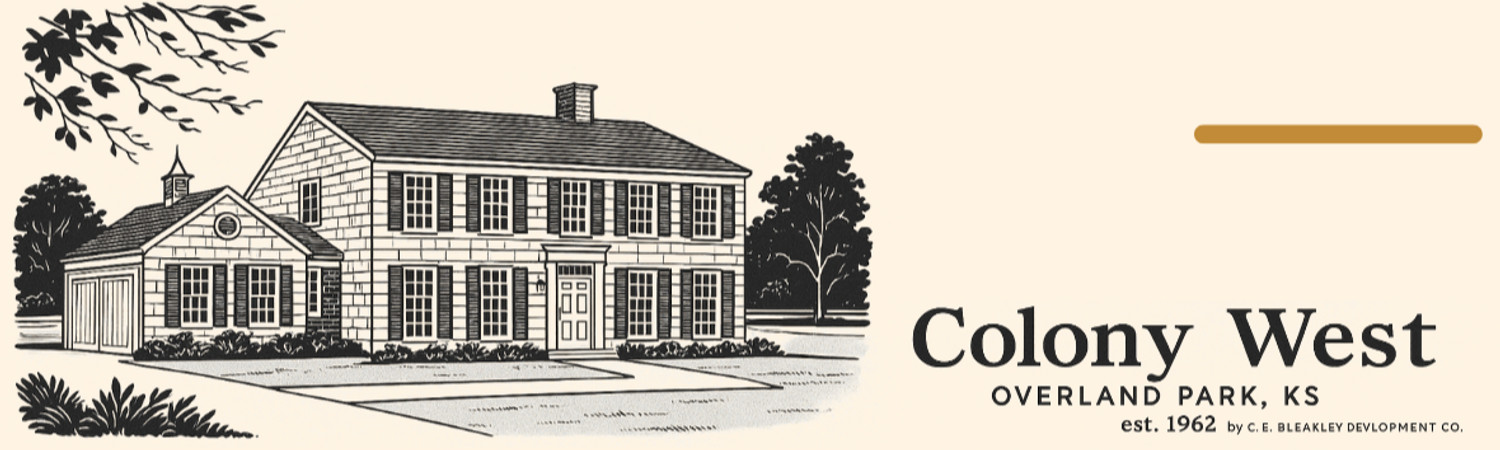
Our History
The History of Colony West
Colony West has a rich and interesting history. The following information has been taken from the Colony West printed directory.
I was curious about our neighborhood. What was here before? Who built such a unique community? How did we come to enjoy our annual neighborhood traditions? The information for this brief history was obtained through the Johnson County Public Library, interviews with Mrs. Charles (Jeanne) Bleakley, and information gathered from current residents. - Adele L. Wilcoxen
The Land: Westward Expansion
Before 1853, no white settlers were allowed across the state line into Kansas from Missouri. The land, stretching from the state line to as far west as western Shawnee County, was Indian reservation. The largest plot of which was settled by the Shawnee tribe.
The first white settler was Thomas Johnson, who launched a mission along what today is Mission Road. Hence our postal code “Shawnee Mission” and the “Shawnee Mission Parkway.” This is why Topeka was named Shawnee County. Our county is named after Mr. Johnson.
According to the Johnson County Public Library, the land that is now the Colony West subdivision belonged to numerous property owners. The 1874 county atlas lists 6 property owners owning portions of the neighborhood. The most notable of these names is M. Boone. By 1902, Margaret Boone owned the entire plot that the neighborhood is built upon. In 1922, the property was owned by Morgan Boone, likely Margaret's son.
Based on the 1941 and 1954 aerial imagery of the Colony West property, the land it rests on was farmland before it was developed.
Across the road, in was is today Nall Hills, was the Meadowbrook Stockyard. Stretching from 95th and Nall to the current Mission Middle School property was the Dyche Stockyard. Both were major early suppliers of Kansas City cattle. So the Colony West property rested in between two major suppliers of the Kansas City cattle trade. With the many available water resources along Indian Creek, this made it an ideal location for such operations.
Names in Johnson County are directly derived from this early history. Nall is named after the Nall family, who settled in the northeast corner of the county along what is today Nall Road. Same for the Roe family, Metcalf family, and the Lackmans, etc. As with many names in the county, it's suspected that Indian Valley was named such because it sounded good and continued with a county-wide theme of naming developments in this manner.
The Man: The Vision
Colony West was developed by the Kansas City builder, Charles “Chuck” E. Bleakley. Mr. Bleakley started out working for J.C. Nichols after World War II, selling homes. He worked for two years in the Prairie Village office, and at one point, was named One Million Dollar Man for his sales success. Later, he became the president of the Home Builders Association. In 1980, he received the George Myers Memorial Award, the highest honor for a developer.
According to Mr. Bleakley's wife, Jeanne, Colony West was Mr. Bleakley's first project as a builder and developer. “Nobody wanted to buy property that was so far south in the county,” she said. Nall Road was not paved. And the future Interstate 435 was represented as a dotted line on the builder's sales materials.
Around 1962, Mr. Bleakley purchased most of the land from Margaret Roe “Jimmy” Bartle Taylor, the only child of renowned Kansas City businessman H. Roe Bartle. Mr. Bartle was a businessman, philanthropist, Boy Scout executive, and professional public speaker who served two terms as mayor of Kansas City, Missouri. After Mr. Bartle helped lure the Dallas Texans American Football League team to Kansas City in 1962, owner Lamar Hunt renamed the franchise to the Kansas City Chiefs after Mr. Bartle's nickname, “The Chief.” Bartle Hall is named in his honor. Margaret lived in a house on the property. It is purported to be the Bartle family farm. Margaret continued to live in the farmhouse on Nall when Mr. Bleakley started building homes in the area.
Mr. Bleakely focused his first development on two-story homes. He thought two-stories made good business sense because they were efficient and more economical to own. Mrs. Bleakley said “People thought he was crazy for wanting to building two story homes. Ranch and tri-level were so popular back then.”
The original Colony West subdivision started out on 101st Terrace. Resident Carol Skidgel shared that the original subdivision only consisted of the house at 10103 Nall and the houses on 101st Terrace. She says Mr. Bleakley told her the lots were deep because the city wouldn't let him put in another east/west street. Mrs. Bleakley says the power lines determined the lot layout. The city would not allow Mr. Bleakley to build underneath them. Several of the homes built on the street were model homes. The homes sold quickly, many to out-of-towners looking to relocate.
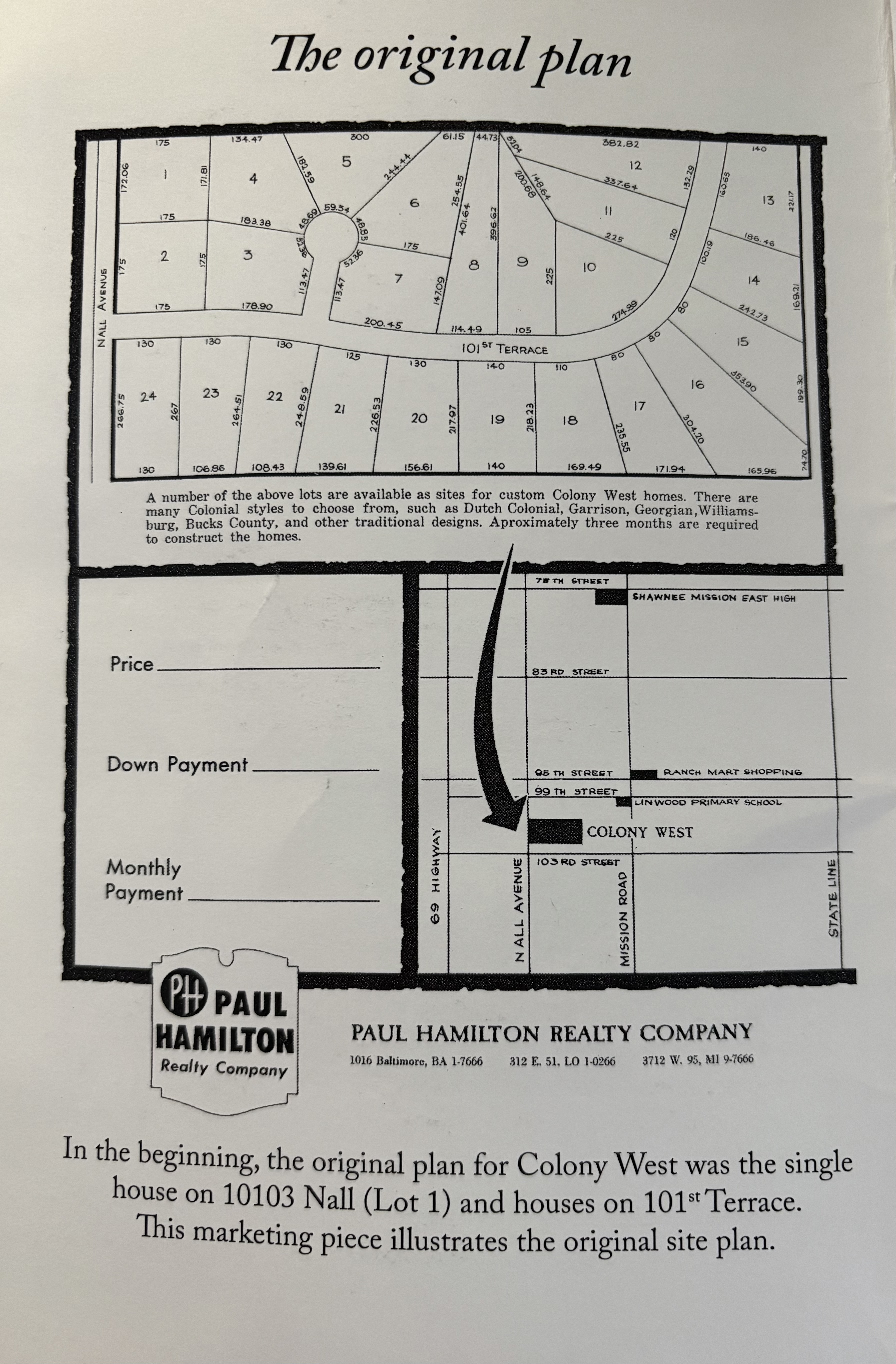
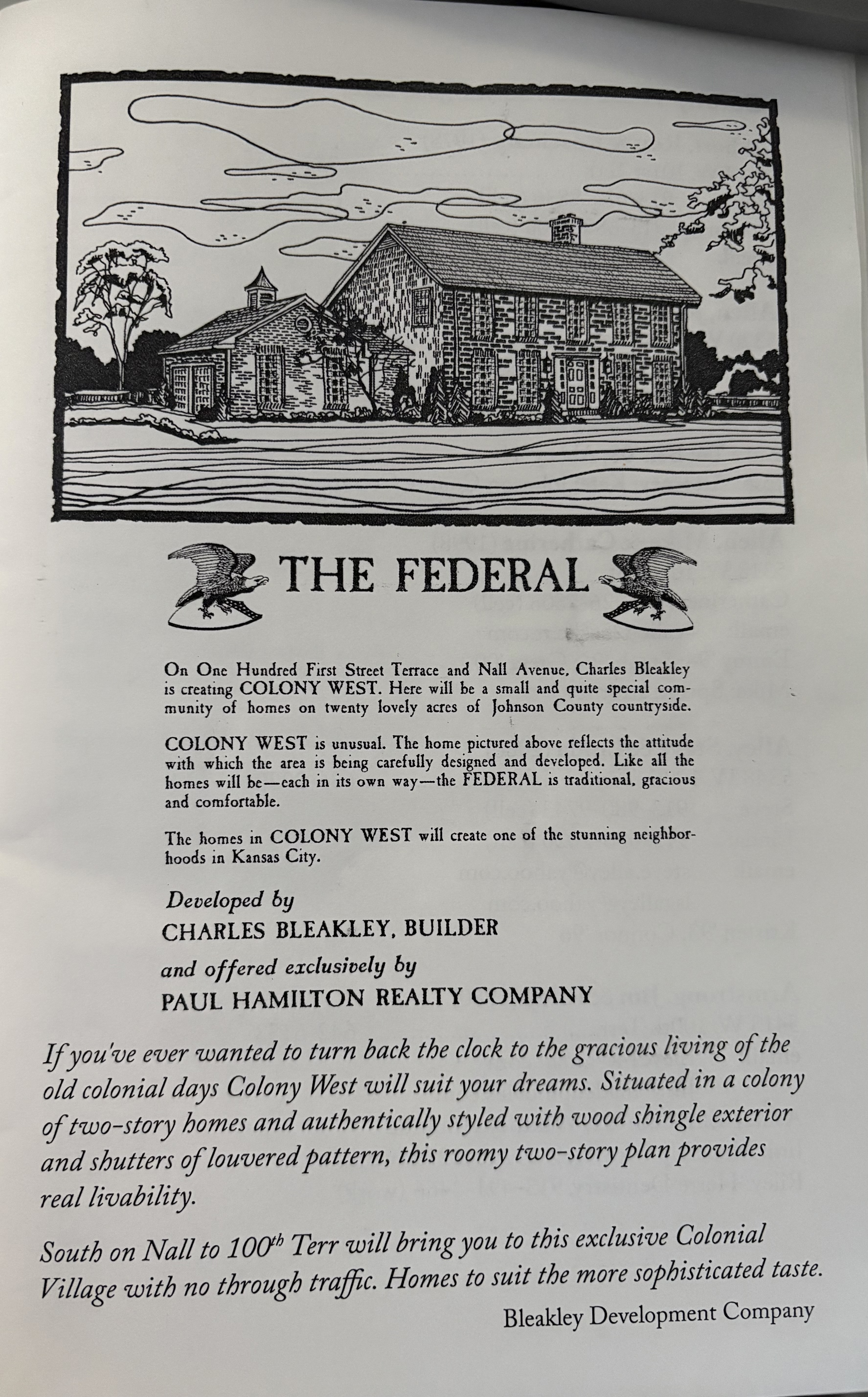
In the summer of 2014 during a neighborhood open house tour, resident Kathy Busch talked with Mr. Bleakley. He told her the City of Overland Park apparently caught wind of the fast-selling homes with big lots. They were concerned that buyers would prefer the Colony West homes and would hurt the sale of ranch-style homes that were predominant in the area at the time.
Margaret Bartle eventually moved out of her farmhouse and that land became available. Ms. Skidgel said the other two streets that are now included in the development, 100th Terrace and 100th Street were not part of the original plans for Colony West. These two streets were in Indian Valley Estates, a development started by another developer who ran into financial difficulties, affording Mr. Bleakley the opportunity to step in and complete the buildout using his Colony West floor plans.
Ms. Busch said the city told Mr. Bleakley he could still build two story homes but had to cut the lot size. That is why the homes on 100th Terrace sit on smaller, uniformed-size lots.
Because the homes on 100th Terrace were constructed by Mr. Bleakley, the matching Colony West monument was placed at the corner of 100th Terrace and Nall. Mrs. Bleakley said Taylor Bradley, of Leo Bradley Real Estate Company built houses on 100th Street, which may explain the absence of a Colony West monument. Today, residents consider all of the homes located on the three streets as part of the Colony West Community. In its entirety, Colony West consists of 40 acres.
Mrs. Bleakley said Mr. Bleakley's vision was to create a neighborhood where the residents would feel a sense of collectiveness. As she remembered it, Mr. Bleakley did not want the streets to continue through and connect to streets on the other side of the creek that borders our neighborhood. He did not want any heavy traffic passing through. He frequently brought his sons Todd and David and daughter Dana to the job site to witness its progress and share with them his pride. Mr. Bleakley considered Colony West one of his greatest achievements. Residents paid their respect to the Bleakleys with a neighborhood progressive dinner in recognition of his accomplishment that has touched so many lives.
Fifty-six years after Chuck Bleakley first broke ground, children still feel safe enough to play in the streets. Neighbors still greet each other with a wave and a smile. And many residents who grew up as children in Colony West, who then went away to college and started their own families, have moved back so their children can enjoy the same wonderful sense of a close-knit community.
Mrs. Bleakley put it best when she said, “Chuck was a fine, fine man.” We are grateful for his vision and his living legacy, Colony West.